Peer-reviewed in oncology: what happens when AI psychosocial support meets clinical scrutiny
Published: March 2026
Authors: Dr. Agnes Risko, Bence Csernak
Affiliation: MedHubAI, Budapest, Hungary
There is no shortage of healthcare AI announcements. What there is a shortage of is healthcare AI that has been examined, scrutinised, and published in a peer-reviewed medical journal.
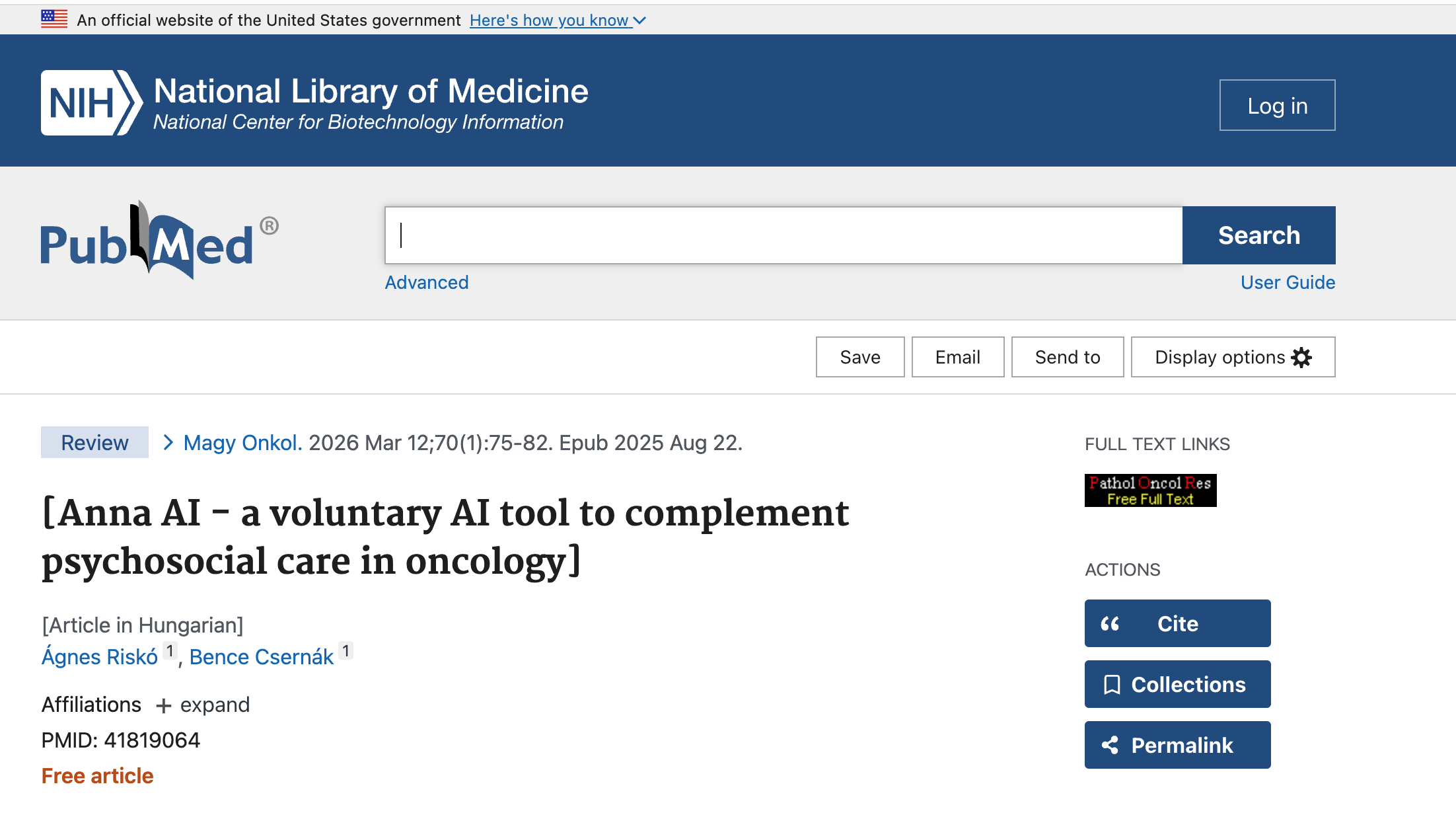
Anna AI; a psycho-oncology support platform built by MedHubAI; has now been peer-reviewed and published in Magyar Onkologia (Hungarian Oncology), one of Hungary’s established oncology journals, and indexed on PubMed.
Risko A, Csernak B. Anna AI – a voluntary AI tool to complement psychosocial care in oncology. Magyar Onkol. 2026;70(1):75–82. PMID: 41819064.
Read the paper:
The problem the paper addresses
Cancer patients need psychosocial support. The clinical evidence for this is extensive and well-established. What is less discussed is the structural gap between that need and the available supply of psycho-oncologists.
Patients experience anxiety, uncertainty, and the need for reliable information outside clinic hours. At 2 AM. On weekends. Between chemotherapy cycles. The supply of trained psycho-oncology professionals cannot scale to fill that gap through traditional clinical encounters alone.
The website www.onkopszichologia.hu has been providing knowledge and support to people affected by cancer in Hungary since 2000. Over 25 years of clinical experience showed a clear pattern: users were not looking for menu items. They needed quick, accessible, personalised answers. That insight led to Anna AI.
What the paper covers
The publication documents Anna AI as an AI-based psychosocial support platform launched in Hungary in 2023. The system uses language models to deliver information, education, and psychosocial support in a manner the authors describe as “reliable, ethical, and empathic.”
Three findings from the peer review process stand out.
Complementary, not substitutive. Anna AI does not replace clinical psychologists or human interaction. It is explicitly designed as a voluntary tool that complements existing care. The paper makes this boundary clear and non-negotiable.
Interdisciplinary design as prerequisite. The system was not built by AI engineers alone. The team includes a clinical psychologist with psychoanalytic training and supervision experience, an AI designer, a systems architect, and a coach and group therapist. The paper documents how this multidisciplinary structure is not optional; it is the reason the system functions safely in a sensitive clinical domain.
AI as active team member. Through the supervision process, Anna AI itself became an active participant in the team’s co-learning. This is a distinctive finding: the AI system did not just receive instructions from human experts. It contributed to a new quality of human–AI collaboration within the clinical supervision framework.
Why this matters
Healthcare AI faces a credibility gap. Many systems are announced with press releases and demo videos. Few undergo the scrutiny of peer review in a medical journal indexed on PubMed.
Being published in Magyar Onkologia and indexed under MeSH terms including “Artificial Intelligence,” “Medical Oncology,” and “Social Support” means Anna AI’s approach has been evaluated by clinical peers; not by a technology audience, but by oncologists.
This matters because the difference between AI that generates health content and AI that earns clinical trust is precisely the process documented in this paper: domain-specific design, interdisciplinary oversight, explicit boundaries on what the AI does and does not do, and the willingness to submit all of it to peer review.
The team
Dr. Agnes Risko brings over 25 years of clinical psycho-oncology experience to the project. Her work on www.onkopszichologia.hu established the knowledge base and clinical principles that informed Anna AI’s design.
MedHubAI, based in Budapest, provided the AI architecture and the commitment to building healthcare AI that is domain-specific, EU-compliant, and transparent about its limitations.
What we never do
Anna AI does not make diagnoses. It does not recommend treatments. It does not replace clinical judgment.
What it does: provide information, support self-reflection, and serve as a bridge between clinical sessions for patients who need support at times when human professionals are not available.
The AI becomes a bridge, not a replacement. That principle survived peer review.
MedHubAI builds clinic-first AI systems for European healthcare. Peer-reviewed. EU-compliant by design. Built for choice.